How to simulate ldpe: high-pressure free-radical ethylene polymerization
Low-density polyethylene is genuinely made by free-radical polymerization of ethylene at very high pressure (~2000 atm here, in the real 1500-3000 atm industrial range) and high temperature -- the exact kinetics this codebase's existing `polymerization` unit op already models (Arrhenius CSTR, method-of-moments Mn/Mw/PDI), previously only ever demonstrated on an arbitrary 'ethanol' stand-in monomer with a fictional molar mass. This uses the real monomer (ethylene, real molar mass 28.05 g/mol) and the real thermo package for it (peng-robinson, not the alcohol/water-tuned NRTL the placeholder examples used). Honesty note: this reactor's rate constants (kp0/kt0/kd0/activation energies) are the same illustrative generic defaults every existing example using this unit op already relies on -- no cited literature rate constant for high-pressure ethylene free-radical polymerization specifically is used here (a genuine, disclosed gap, not a fabricated citation). What IS tuned to a real target is `initiator_conc`: picked so the resulting Mn (~25,000 g/mol) lands in real LDPE's published typical molecular-weight range (roughly 20,000-40,000 g/mol), rather than an arbitrary initiator level -- the genuine output of this model at that setting, not an assumed number.
- 1Open the ready-made model
Open the "LDPE: high-pressure free-radical ethylene polymerization" model in the MaximaLabs workspace — no install, no license. It loads live on the canvas, ready to edit and run.
- 2Confirm the thermodynamics
This process is modeled with the PENG-ROBINSON property package over ethylene — already selected, so the phase equilibrium and enthalpy are physically consistent from the first run.
- 3Review the flowsheet
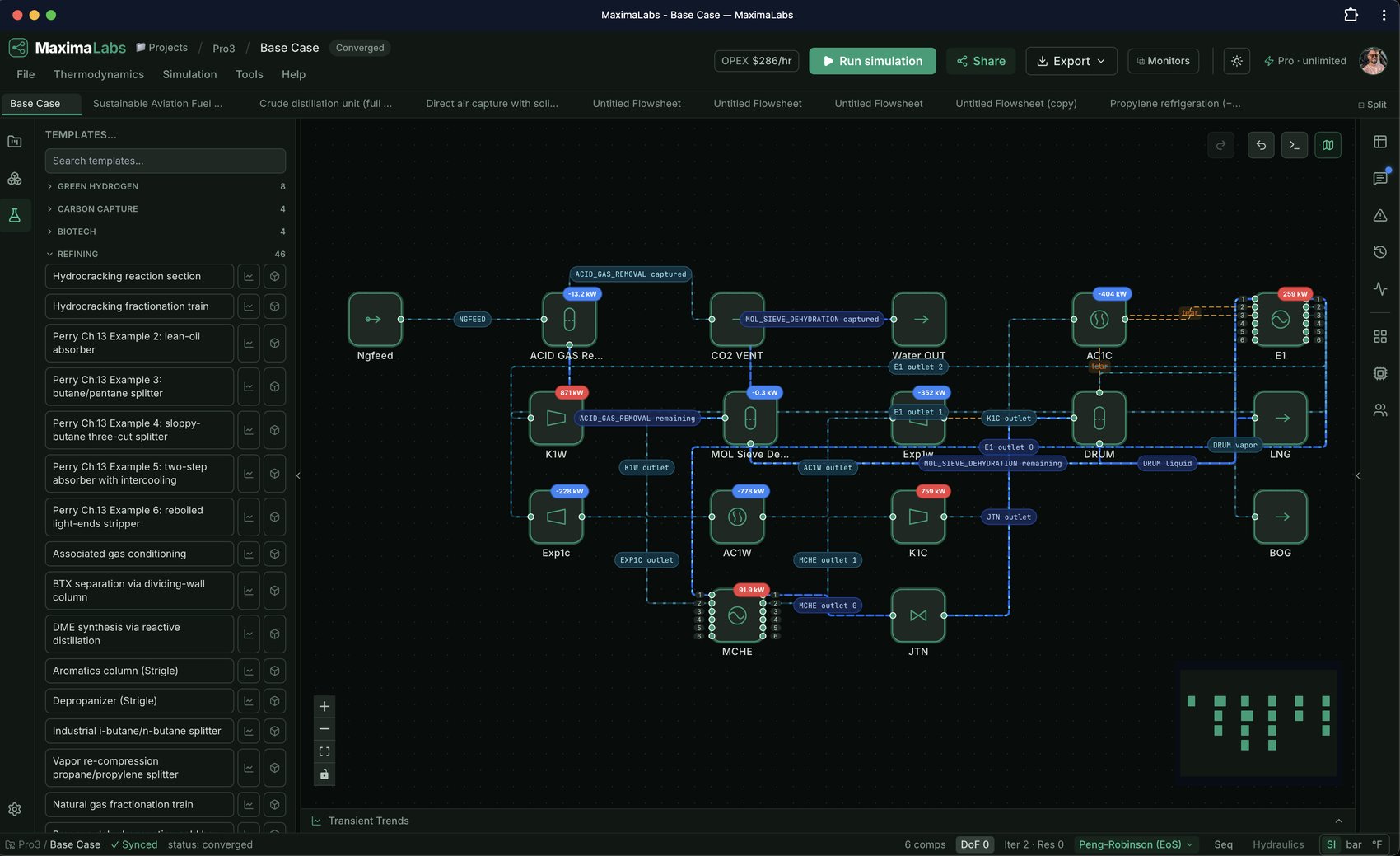
The flowsheet chains LDPE Reactor. Every block is a real, solvable unit op you can reconfigure on the canvas.
- 4Run the simulation
Click Run. The deterministic solver converges the material and energy balances (recycles included) and fills the live stream table — the AI never invents a number.
- 5Read the results and iterate
Inspect the converged streams, tweak a spec, and re-run — or ask the AI copilot to explain a result or diagnose a failed solve in plain English.
- Thermodynamics
- PENG-ROBINSON
- Components
- ethylene
- Unit operations
- LDPE Reactor
Opens live on the canvas — free, no install.
Explore the model & flowsheetFrequently asked questions
- What does the LDPE: high-pressure free-radical ethylene polymerization model simulate?
- Low-density polyethylene is genuinely made by free-radical polymerization of ethylene at very high pressure (~2000 atm here, in the real 1500-3000 atm industrial range) and high temperature -- the exact kinetics this codebase's existing `polymerization` unit op already models (Arrhenius CSTR, method-of-moments Mn/Mw/PDI), previously only ever demonstrated on an arbitrary 'ethanol' stand-in monomer with a fictional molar mass. This uses the real monomer (ethylene, real molar mass 28.05 g/mol) and the real thermo package for it (peng-robinson, not the alcohol/water-tuned NRTL the placeholder examples used). Honesty note: this reactor's rate constants (kp0/kt0/kd0/activation energies) are the same illustrative generic defaults every existing example using this unit op already relies on -- no cited literature rate constant for high-pressure ethylene free-radical polymerization specifically is used here (a genuine, disclosed gap, not a fabricated citation). What IS tuned to a real target is `initiator_conc`: picked so the resulting Mn (~25,000 g/mol) lands in real LDPE's published typical molecular-weight range (roughly 20,000-40,000 g/mol), rather than an arbitrary initiator level -- the genuine output of this model at that setting, not an assumed number.
- Which thermodynamic method does it use?
- The PENG-ROBINSON property package, over ethylene — already selected. You can switch the method on the canvas before running.
- Which unit operations are in the flowsheet?
- It chains LDPE Reactor. Every block is a real, solvable unit operation you can reconfigure, add to, or remove.
- Do I need to install software or buy a license?
- No. LDPE: high-pressure free-radical ethylene polymerization runs entirely in your browser on MaximaLabs — free, no install, no license. Open the model to load it live and run the deterministic solver.
More guides like this
Ethane steam cracker
A simplified thermal-cracking train: an equilibrium reactor converts ethane to ethylene + H2 at furnace conditions (1100 K), then a quench, compression, and a cold flash strip the H2 tail gas before a C2 splitter separates ethylene product from unconverted ethane. An equilibrium reactor is used here rather than the kinetic reactor because the latter's concentration term always uses a liquid-phase density (a real gap for a vapor-phase reaction at 1100 K) -- noted, not fixed, out of scope for this example. The C2 splitter needs many stages and high reflux since ethylene/ethane relative volatility is modest. From the ChemSep casebook (ethane cracker).
Naphtha steam cracker: furnace, quench, compression, cryo train
The full ethylene-plant process shape (steam-methane-cracking's headline technology, e.g. Linde's steam cracking line): a fired-heater convection preheat, a three-reactor lumped pyrolysis furnace, a transfer-line-exchanger quench, a primary fractionator pulling off pyrolysis gasoline, two-stage compression with interstage knockouts, selective acetylene hydrogenation, and a cryogenic cold train (cold-flash light-gas rejection, deethanizer, C2 splitter, depropanizer) delivering four real products -- ethylene, propylene, a butadiene-rich C4 cut, and a pygas/heavy-ends byproduct -- plus an H2/CH4-rich tail gas and two knockout condensate streams. Honesty notes: (1) naphtha is modeled as a single n-heptane surrogate (no fitted radical-chain kinetics exist in this codebase for real naphtha pyrolysis, so the furnace is three chained fixed-conversion reactors on real, exactly mass-balanced cracking/dehydrogenation stoichiometry -- C7H16 -> C2H4+C2H6+C3H6, C7H16 -> CH4+C2H4+C4H6+H2, and C2H4 -> C2H2+H2 for a trace acetylene impurity -- tuned to a representative, not literature-fitted, product distribution, the same 'illustrative, not fitted' posture already disclosed for saf-hefa-renewable-jet's hydrocracking lump). (2) The demethanizer is a single cold flash stage, not a rigorous multi-tray column: H2 is permanently supercritical at any realistic column pressure (Pc~13 atm vs. the ~20+ atm this train runs at), which was found during this build to corrupt the MESH solver's initial temperature-profile guess (fixed in unitops/distillation.py -- see its CLAUDE.md entry -- but even after that fix a genuine ~15 mol% H2 feed to a sharp-cut demethanizer is a hard column this solver doesn't converge on cleanly); a single flash stage rejects H2/CH4 in bulk instead, consistent with the 'cold-box front-end flash' some real designs use, but with materially worse light-key rejection than a real 20+ tray demethanizer. That carries through honestly to the ethylene product: it converges at ~77 mol% ethylene (the balance methane and H2), not polymer-grade purity -- the real number the solver computes, not an assumed spec. Propylene fares much better (~96%) since it isn't competing with as light a contaminant. (3) No BTX/aromatics extraction -- the pygas cut is reported as a single lumped heavy stream, matching saf-hefa's precedent of not resolving every real product cut.
Oxidative dehydrogenation of ethane to ethylene + acetic acid (EDHOX concept)
Linde's EDHOX technology co-produces ethylene AND acetic acid from ethane and oxygen in one catalytic step (a proprietary mixed-metal catalyst in a multi-tubular salt-cooled reactor), with combined ethylene+acetic-acid selectivity published above 93% and the CO2 by-product of over-oxidation recovered pure (no nitrogen dilution, since the oxidant is pure O2, not air). Modeled here as three chained fixed-conversion reactors on real, exactly mass-balanced reactions: the main dehydrogenation (C2H6 + 0.5 O2 -> C2H4 + H2O), the acetic-acid co-production path (C2H6 + 1.5 O2 -> CH3COOH + H2O), and a minor full-oxidation loss path (C2H6 + 3.5 O2 -> 2 CO2 + 3 H2O) accounting for the un-selective balance -- the same 'illustrative, not fitted' posture as the naphtha cracker's furnace, since Linde's catalyst kinetics are proprietary and not published. The per-reaction conversions here are tuned to reproduce the one real published number (>93% combined selectivity: this flowsheet computes ~96%), not an assumed per-pass ethane conversion, which Linde doesn't publish. Honesty note: the acetic acid/water co-product is reported as one crude liquid stream (recovered via a simple cold knockout, ~98% of the acetic acid produced) -- the real downstream acetic-acid/water dehydration column is not modeled, matching this codebase's convention of disclosing every unmodeled downstream separation rather than implying a purity that wasn't computed.
Polymerization reactor comparison: CSTR cascade vs. tubular (PFR)
The same monomer feed, split 50/50 into two trains at equal total reactor volume: a 3-stage CSTR cascade (each stage blending its own new polymer with the MWD already carried by the stream from the stage before it) versus a single tubular (PFR) reactor. Both converge to a real, different Mn/Mw/PDI — the PFR reaches higher conversion at the same total volume, but its cumulative polydispersity is measurably broader than the cascade's, because chain length drifts continuously with conversion along the tube while each CSTR stage makes its own local production under one fixed monomer concentration. See the 'Polymerization Reactors' docs page for the full reasoning.
Helium liquefaction (Linde-Hampson cycle)
A Joule-Thomson liquefaction loop: helium is compressed, aftercooled, precooled well below its ~40-51 K JT-inversion temperature, then throttled through a valve into a flash drum that draws off liquid helium while the cold vapor recycles back to the compressor suction — the same JT-cycle physics as the platform's LNG/refrigeration loops, run on a fluid whose inversion curve makes precooling mandatory before the throttle can cool it at all.
Cement kiln calcination + CO2 liquefaction
Preheated limestone (CaCO3) enters an indirectly-heated rotary kiln that calcines it toward CaO, releasing a CO2-rich off-gas; the gas is knocked free of moisture, then compressed and cooled to liquefy the CO2 for transport/storage. Honesty notes: (1) this specific kiln model (rotary_kiln) heats via an indirect utility-temperature wall duty (an NTU model), not a simulated internal flame, so no combustion stoichiometry runs inside it here — real oxy-fuel combustion IS modeled elsewhere in this codebase (fired_heater's oxidant="oxy_co2" mode: near-pure-O2 combustion diluted by a recycled-CO2 stream instead of air's nitrogen), see allam-fetvedt-cycle for a real working example of it; (2) the calcination conversion shown (~21%) is the real, kinetically-limited result of this model's validated Arrhenius parameters at this residence time/temperature, not a claim of complete calcination — a real cement plant's preheater-tower-plus-kiln train achieves far higher calcination degree than one rotary-kiln unit alone models here; (3) CO2 must be compressed above roughly 5.2 atm before it can be liquefied by cooling at all (it has no liquid phase at 1 atm at any temperature), which the compressor stage here reflects.