The AI-Native Process Simulator — From Flowsheet to Live Digital Twin
Build, solve, and auto-calibrate complex process simulations directly in your browser. A 10x faster workflow than desktop software or license-server delays.
No software installation or credit card required · Opens instantly in browser
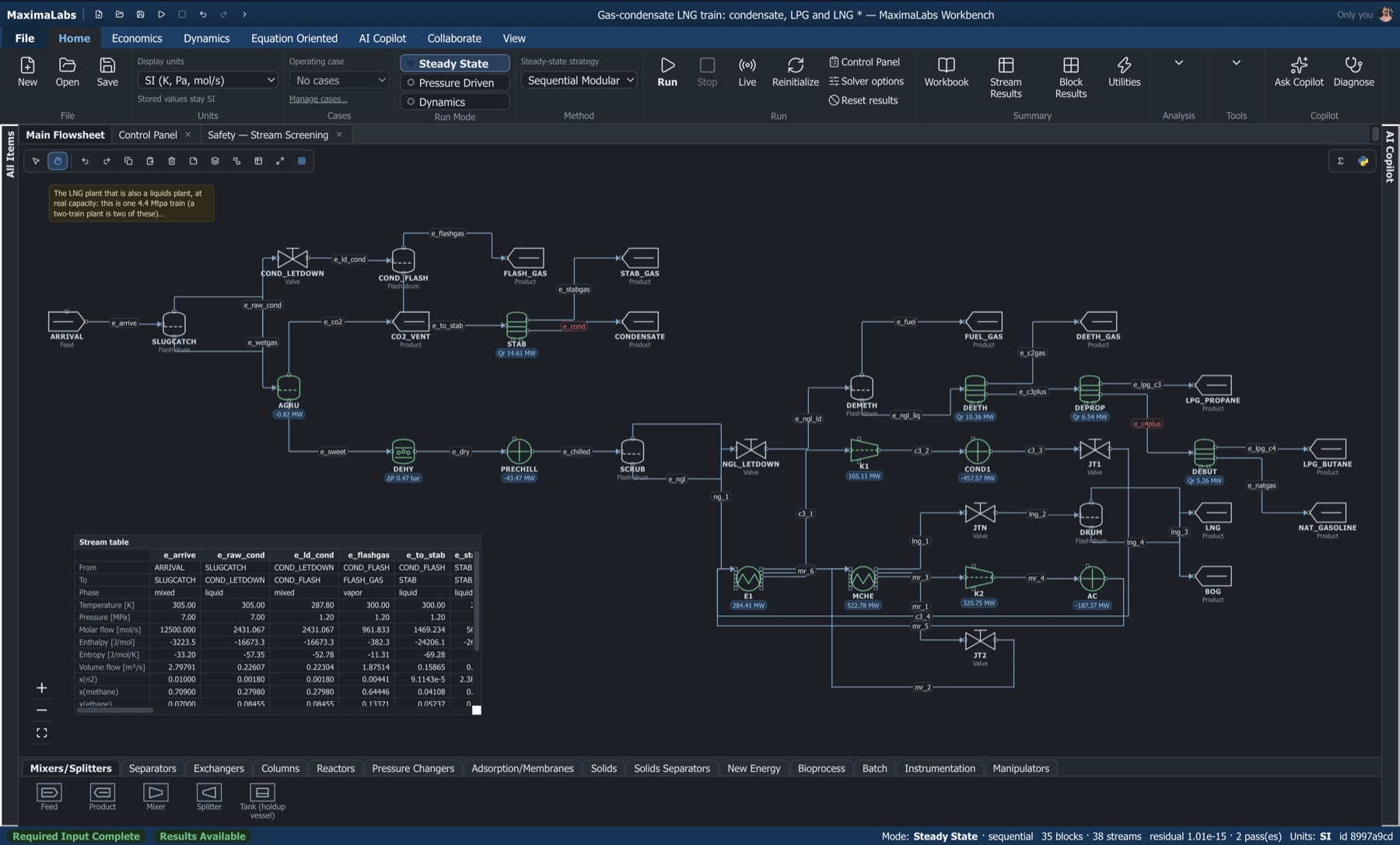
A real converged run — a gas-condensate LNG train as one flowsheet: slug catcher, condensate stabilizer, acid-gas removal and dehydration, then NGL fractionation (deethanizer, depropanizer, debutanizer) and a propane-precooled mixed-refrigerant liquefaction loop — 35 blocks solved together into condensate, LPG, natural gasoline and LNG.
- unit operations
- 110+
- unit operations
- components in the databank
- 25,000+
- components in the databank
- property packages
- 30+
- property packages
- solved example flowsheets
- 250+
- solved example flowsheets
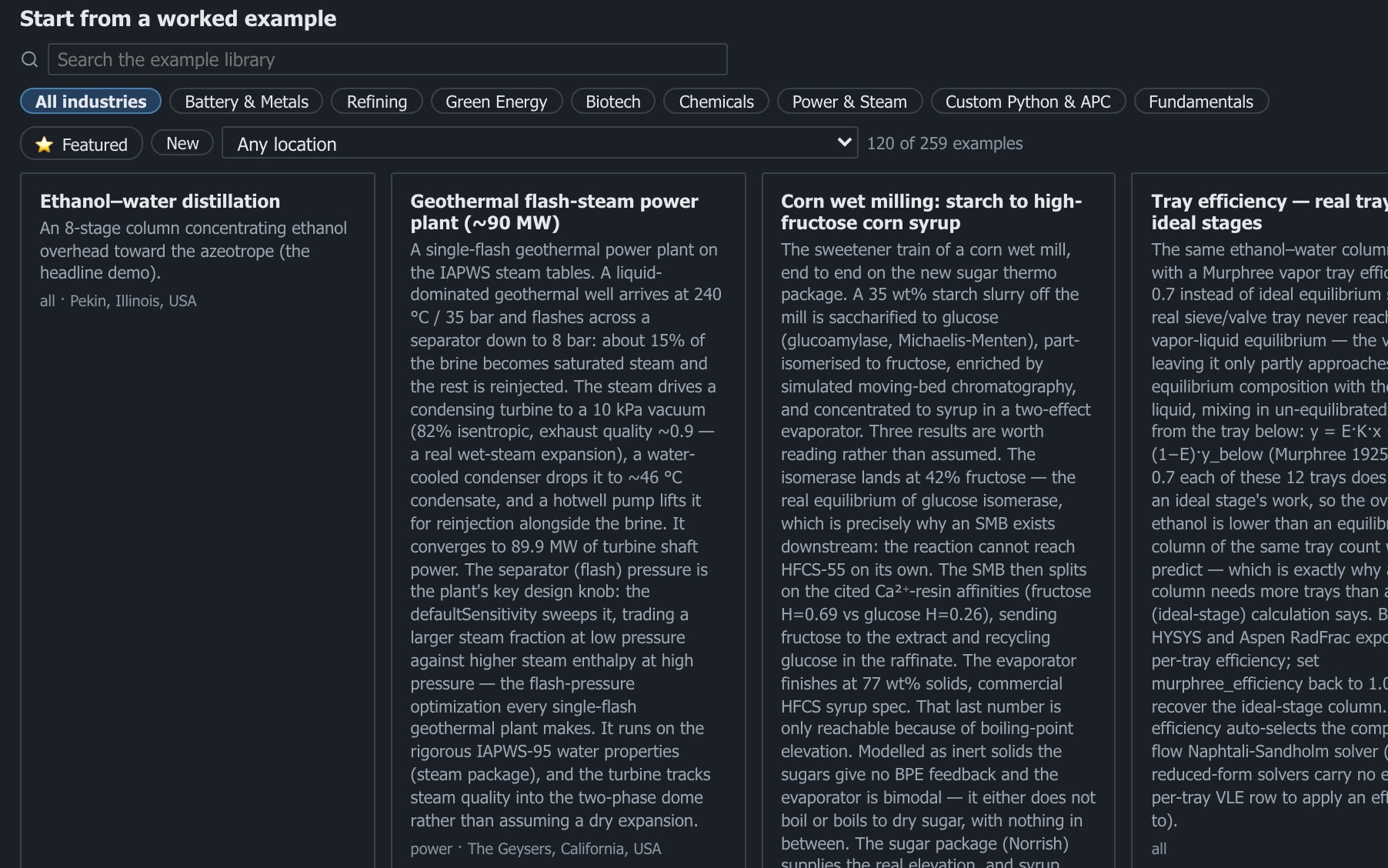
Open a real model, not a demo video
Three production-shaped flowsheets from the library. Each opens live on the canvas — editable, solvable, with the equations behind every block.
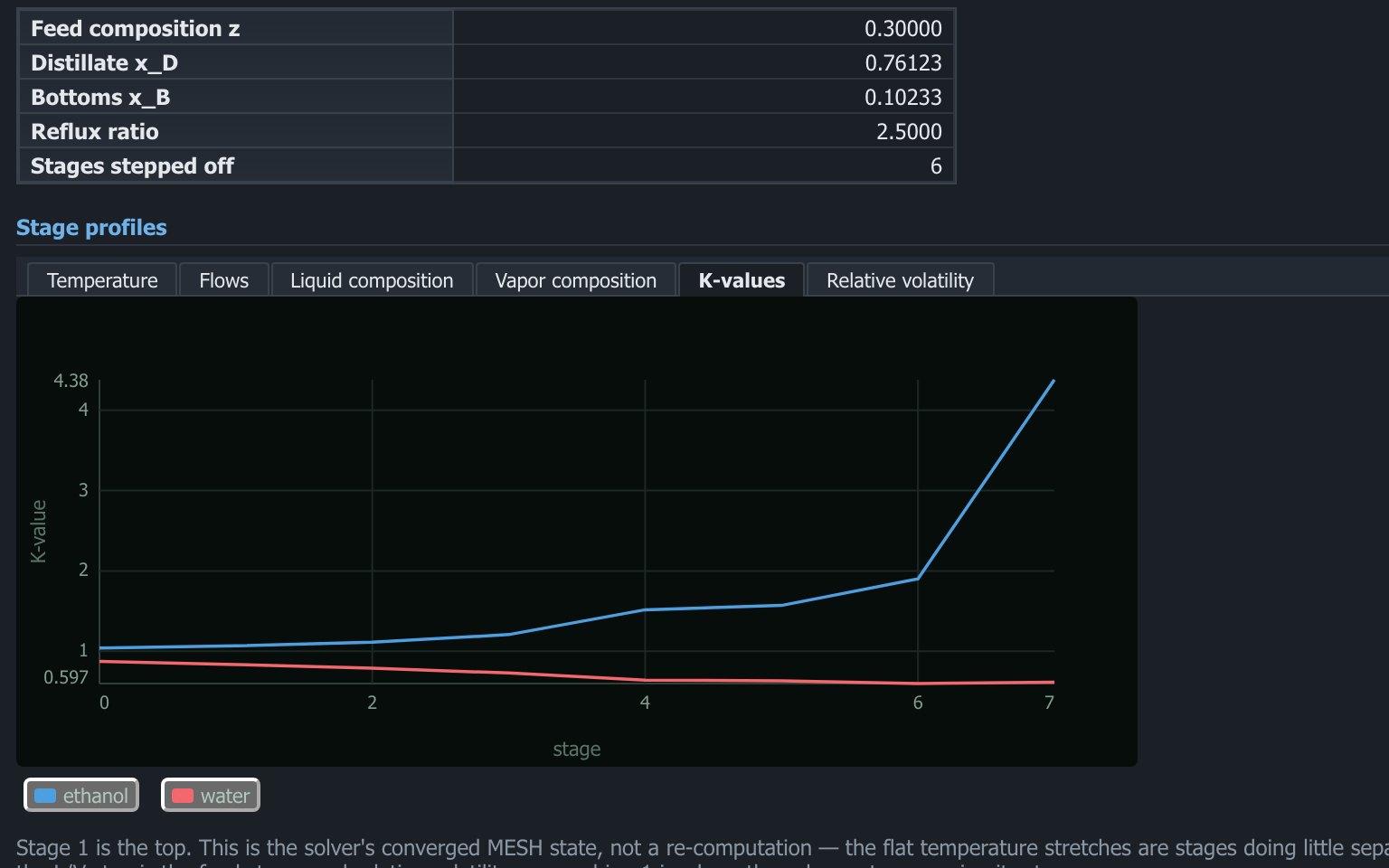
Crude distillation (preset cuts)
A rigorous 14-stage MESH column on Peng-Robinson, with per-stage temperature and K-value profiles.
10 MW PEM electrolyzer loop
A 10 MW PEM electrolyzer stack with its recirculation loop, solved end to end.
Solid-sorbent fluidized-bed DAC with compression heat recovery
Solid-sorbent direct air capture with compression heat recovery, across 14 blocks.
From one sentence to a solved plant
The copilot draws the flowsheet. The solver computes every number.
Describe it
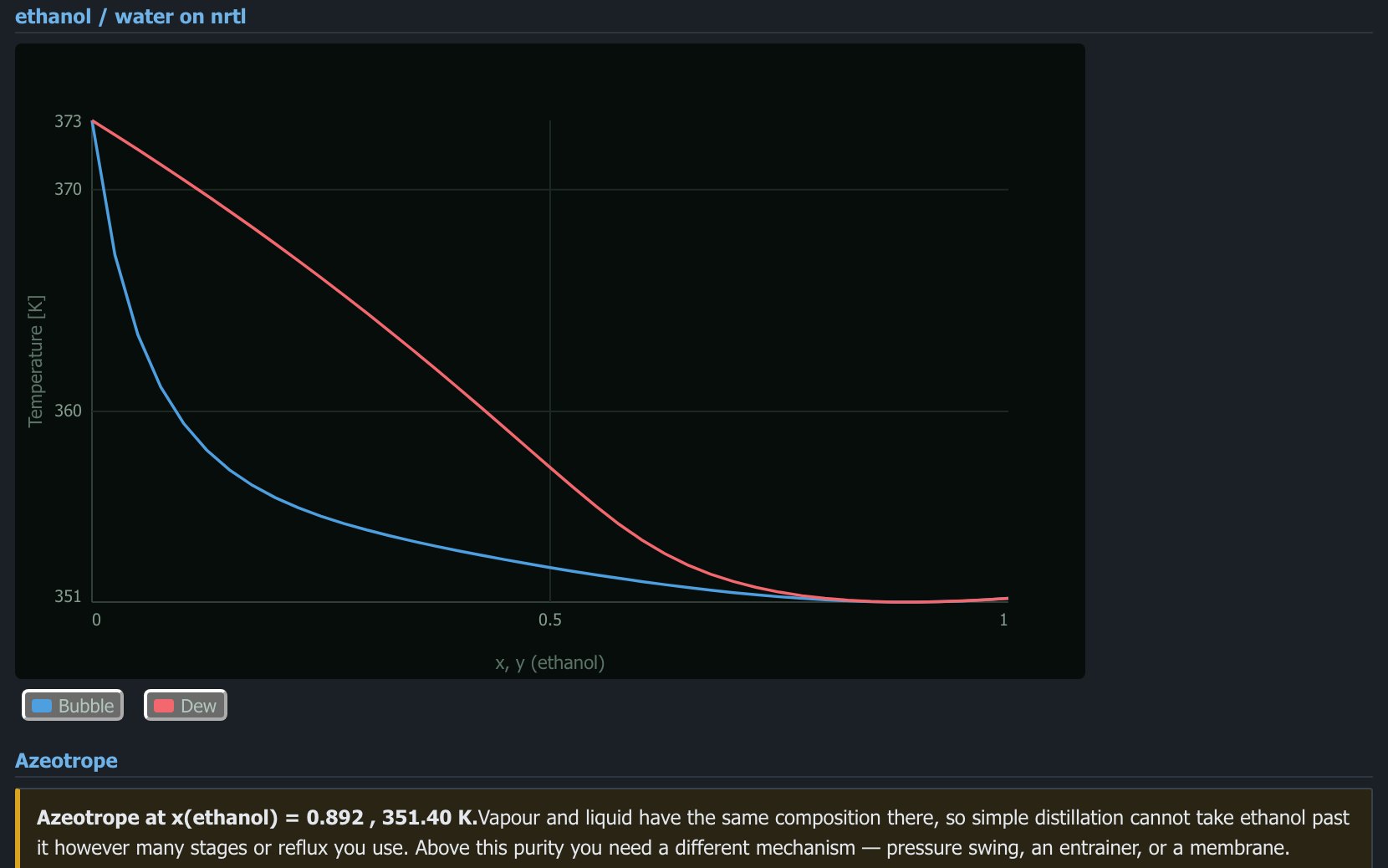
Type the process in plain words. The copilot builds it on the canvas — feed, column and products — and picks a property method that suits the chemistry.
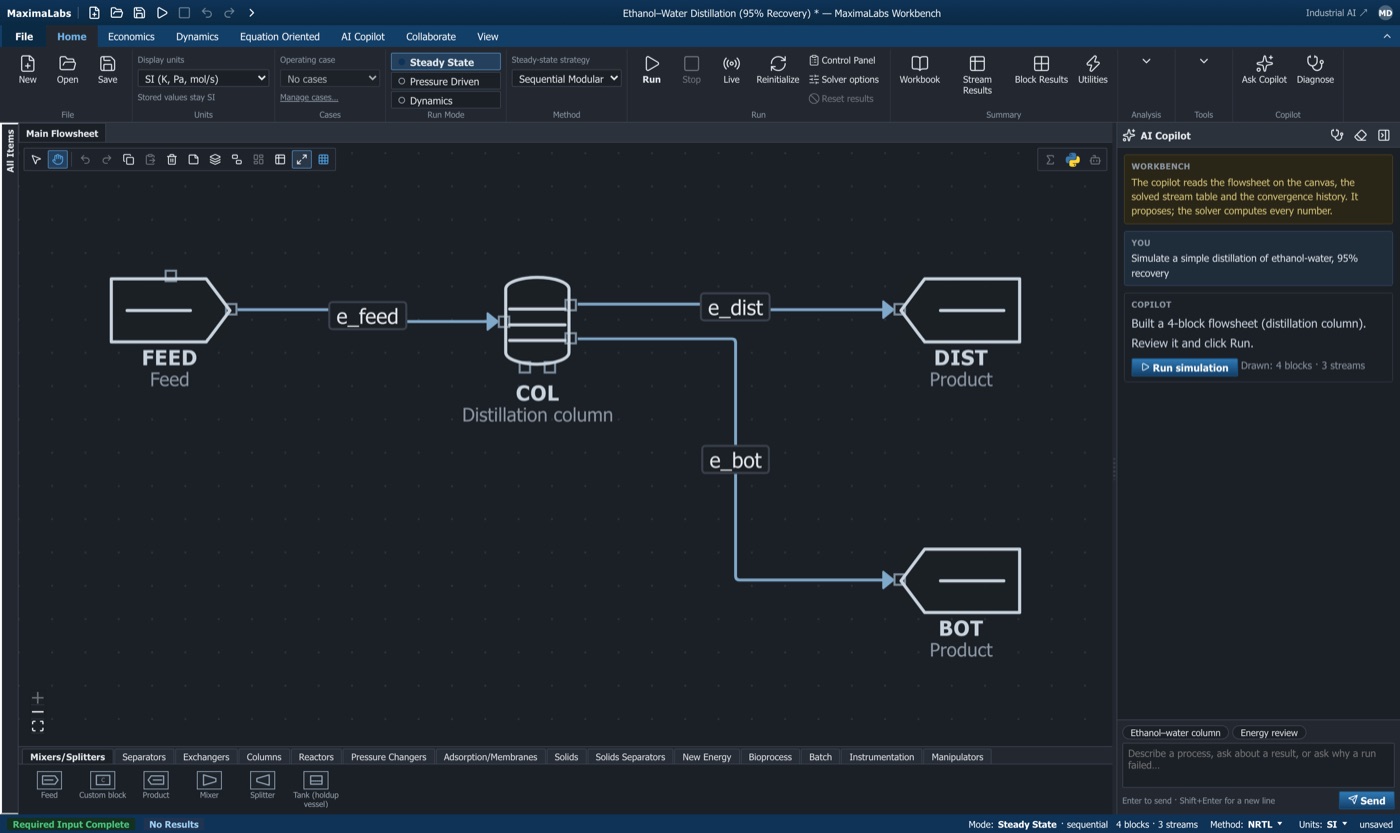
“Simulate a simple distillation of ethanol-water, 95% recovery” — drawn as a four-block flowsheet on NRTL.
Run it
One click solves it. Every duty, temperature and composition comes from the solver; the copilot never invents a number.
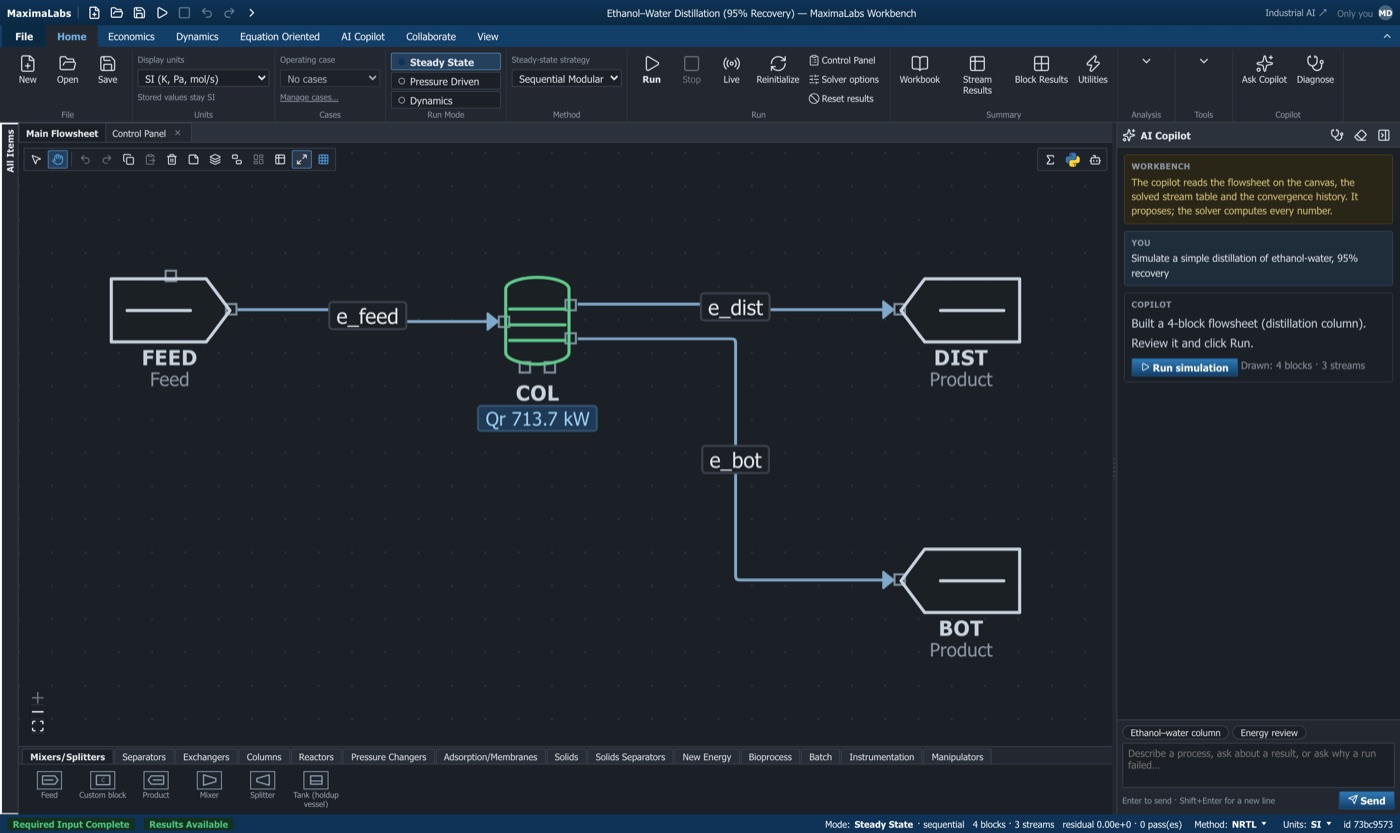
Solved: the column needs 713.7 kW of reboiler duty.
Change it in plain words
Ask for what you want changed. The copilot edits the flowsheet you already have — your blocks stay, the new one is wired in — and the solver runs it again.
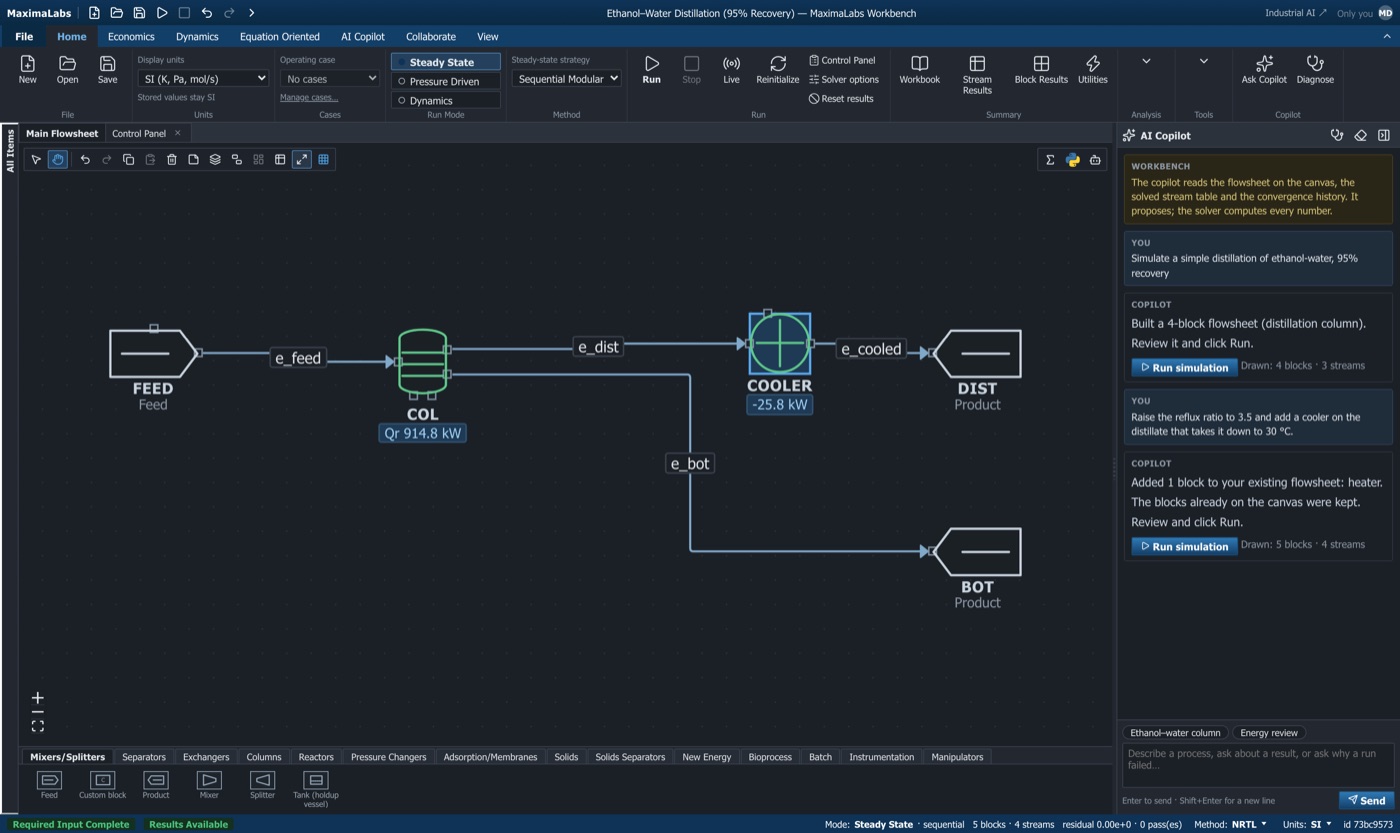
“Raise the reflux ratio to 3.5 and add a cooler on the distillate” — the cooler is added, and the reboiler duty rises to 914.8 kW.
Everything a process study needs
Each piece links to the detail behind it.
Thermodynamics
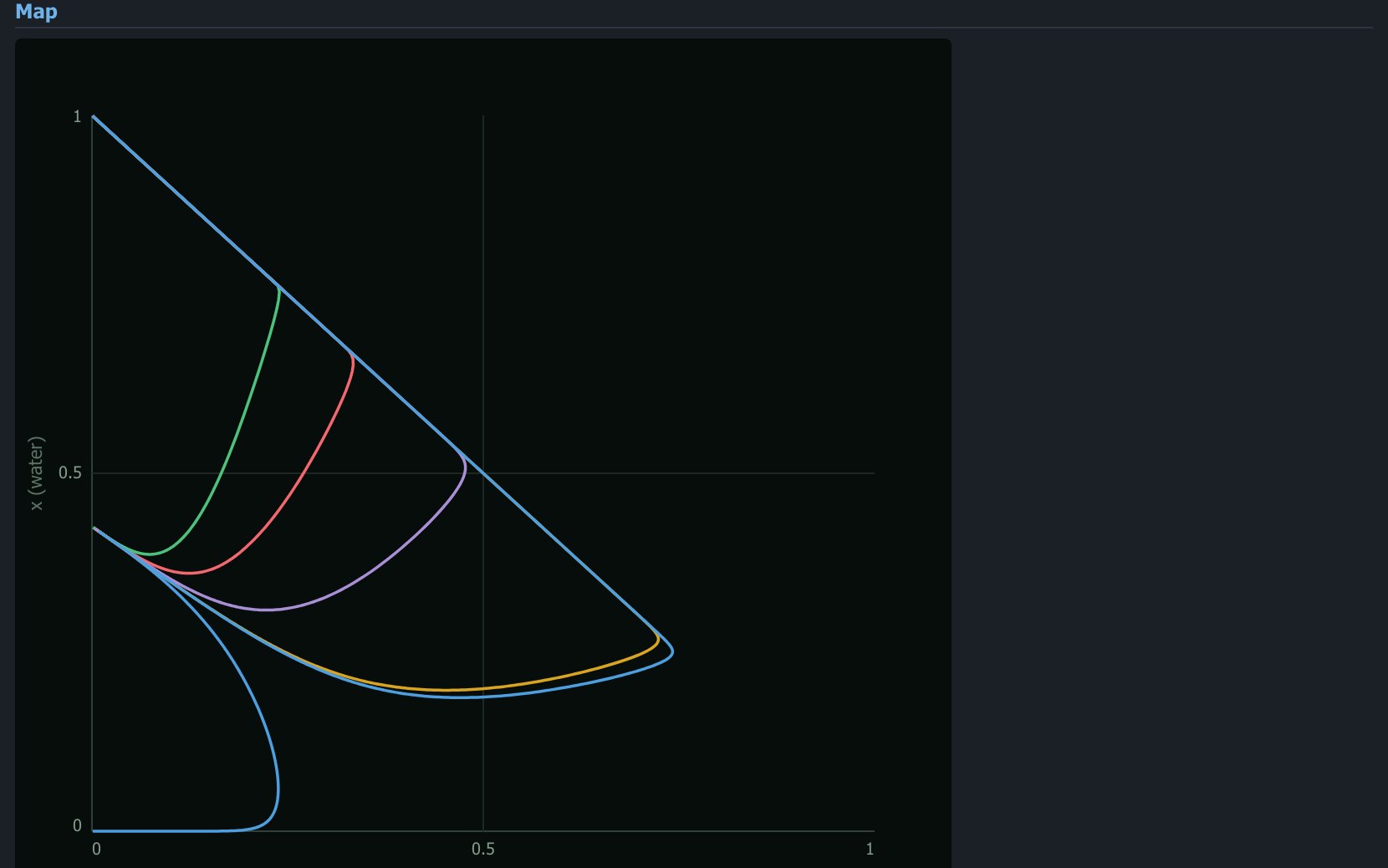
Equations of state, activity models, electrolytes and steam tables, chosen for the chemistry.
→Separations
Rigorous MESH and rate-based columns, extraction, absorption and membranes.
→Solver engine
Sequential modular with recycle acceleration, plus equation-oriented and pressure-driven modes.
→Economics
Capital and operating cost estimates straight from the solved flowsheet.
→Mechanical & piping
ASME vessel ratings, nozzle checks and line sizing.
→Engineering toolkit
Standalone calculators for relief, hydraulics, heat transfer and fluid properties.
→Model-based engineering
Parameter estimation, optimal control, population balances and custom equations.
→Equations
The governing equations, with derivations and Jacobians you can inspect.
→Components
Search the component databank by name or CAS number.
→Worksheets and Excel
Results you can read, compare and take with you.
- Every stream in one table, each value set against the stream it came from
- Molar or mass basis, plus molar mass, density, Z, cp, surface tension and liquid viscosity
- Copy straight into Excel, or export the workbook as .xlsx
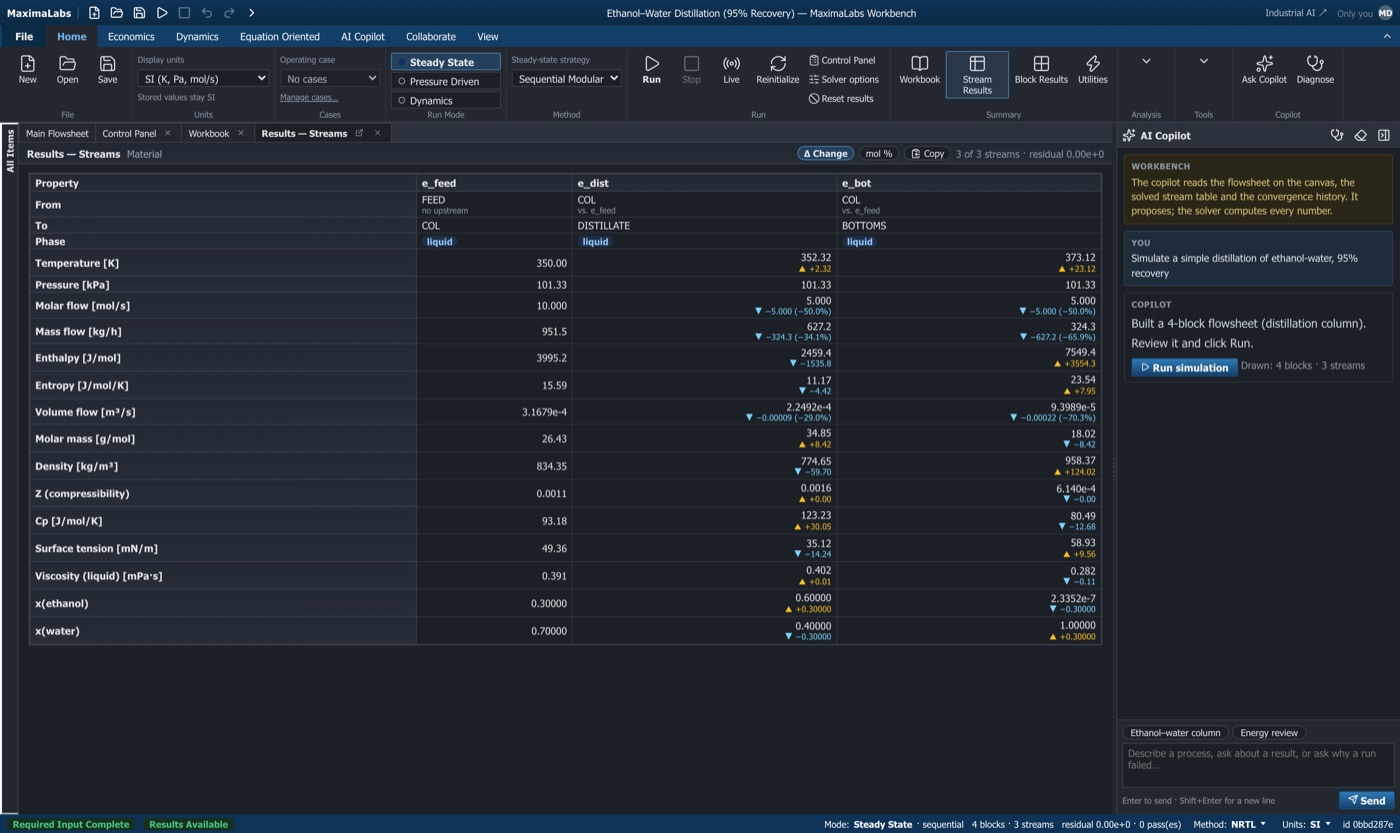
The solved column's streams, each measured against the stream it came from, ready to copy into Excel.
Built for real processes
Open any template and it loads straight onto the canvas — solved and ready to edit.
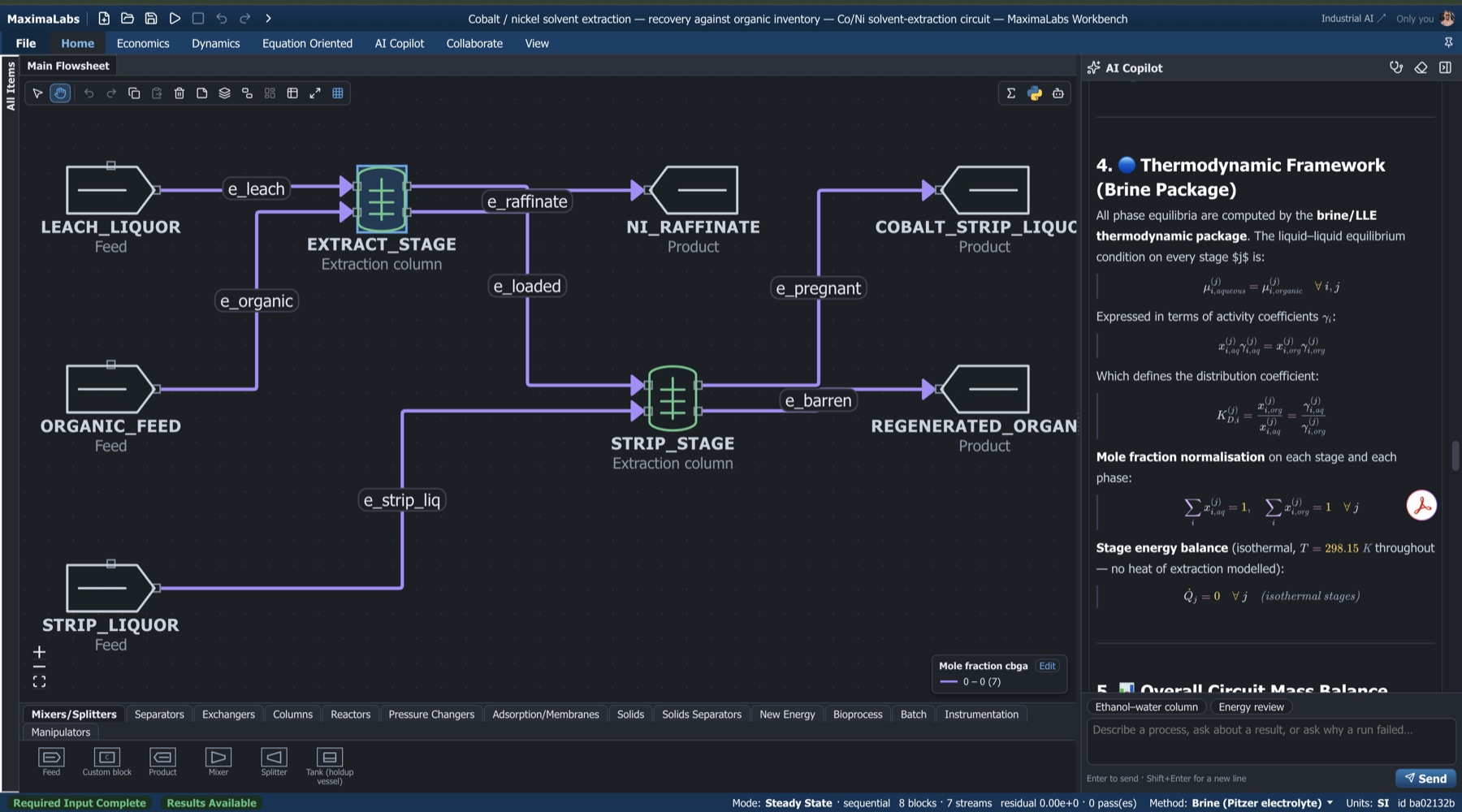
A cobalt/nickel solvent-extraction circuit: the extraction column loads cobalt into the organic and leaves nickel in the raffinate, the strip column recovers cobalt into the strip liquor and regenerates the organic — solved on the Pitzer electrolyte package, with the AI copilot writing out the stage equilibrium it solves.
HYSYS was built for oil & gas. MaximaLabs ships the new-energy unit ops and workflows you actually need.
Questions
What is MaximaLabs?
A process simulator that runs in your browser: steady-state, pressure-driven and dynamic flowsheets, rigorous thermodynamics, and an AI copilot that builds and explains them. There is nothing to install.
Does the AI calculate the results?
No. The copilot proposes a flowsheet or a change and explains it; the deterministic solver computes every temperature, duty and composition you see. A flowsheet from the copilot that does not validate is not applied.
Will it feel familiar if I have used Aspen Plus or HYSYS?
That is the intent. The workbench has a ribbon, an All Items tree, a form for each block and the three run modes — steady state, pressure driven and dynamics — so the habits carry over.
Can it open my Aspen or HYSYS cases?
Aspen Plus .bkp and .apw, HYSYS .hsc and DWSIM files import with deterministic parsing and a report of what was recovered. A HYSYS .hsc import is partial — unit names and types, not connectivity — and the report says so.
Which thermodynamic models are included?
Peng-Robinson and SRK (including Gᴱ mixing rules), NRTL, UNIQUAC, UNIFAC, PC-SAFT, CPA, GERG-2008, electrolyte NRTL, Pitzer and the IAPWS steam tables — more than 30 property packages in all.
Can I script it?
Yes. The Python SDK (pip install flowsim-sdk) creates, runs and reads simulations, and its results are the same objects the canvas shows.
How much does it cost?
It is free to start, with no credit card. Paid plans add higher limits and team features; the pricing page has the details.