Flash & Phase Equilibrium
Chapter 2 chose the thermodynamics. This chapter runs them. The flash — take a feed at some temperature and pressure and ask how it splits into vapor and liquid at equilibrium — is the single most-called calculation in a simulator. A distillation column flashes on every stage on every iteration; a recycle loop flashes thousands of times before it converges. Get the flash right and fast, and everything above it works.
3.1 One equilibrium stage
The simplest unit that is a flash is the flash drum: one feed in, a vapor product and a liquid product out, held at a set temperature and pressure. The reference example below splits an ethanol-water feed at 358 K into an ethanol-rich vapor and a water-rich liquid.
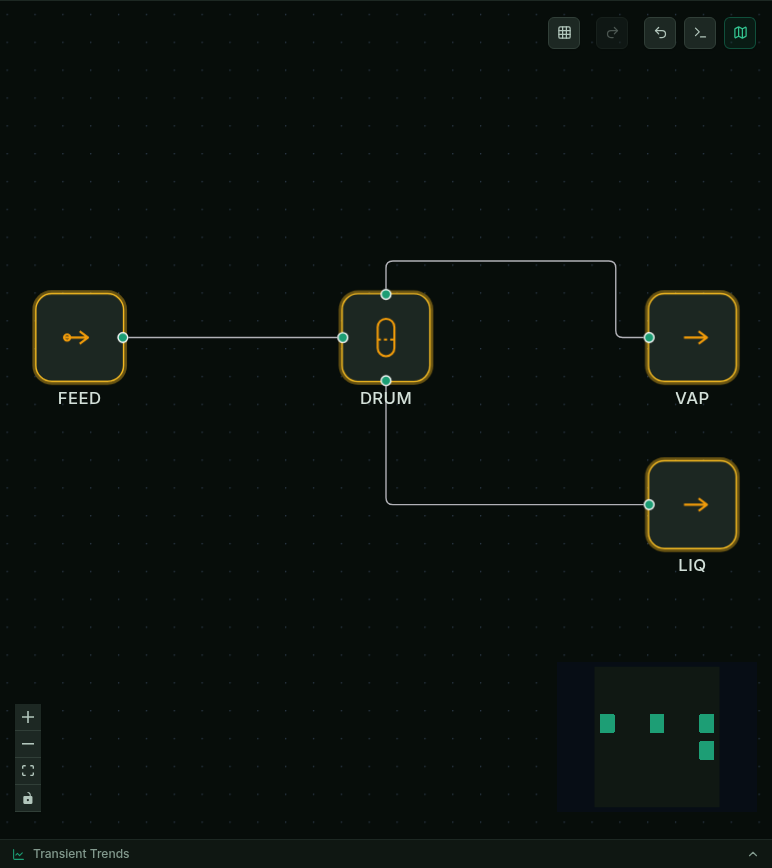
The 'Flash separation' example: FEED → flash DRUM → vapor (VAP) + liquid (LIQ). One equilibrium stage, the atom every column is built from.
3.2 The isothermal flash: Rachford-Rice
Given the feed composition
Requiring both phases' mole fractions to sum to one,
- Feed mole fraction of component i (known — this is the flash's input composition).
- Liquid- and vapor-phase mole fraction of component i (unknowns being solved for).
- Equilibrium ratio K_i = y_i/x_i — how strongly i favors the vapor (from §3.3).
- Vapor fraction — moles of vapor per mole of feed (the one unknown Rachford-Rice solves for; every x_i, y_i follows from it).
It's monotonic in
Feed
Check it:
3.3 K-values, and why the flash iterates
The catch: the K-values
- Liquid activity coefficient — the non-ideality correction Chapter 2's NRTL/UNIQUAC/Wilson models supply; a value of 1 is the ideal (Raoult's-law) limit.
- Pure-component vapor pressure of i at the flash temperature.
- Vapor-phase fugacity coefficient (≈1 near atmospheric pressure; departs from 1 as pressure rises).
- Liquid- and vapor-phase fugacity coefficients of i in the mixture, from an equation of state (PR/SRK) — the EoS route, used instead of an activity coefficient when there's no natural liquid/vapor asymmetry (e.g. near-critical or all-hydrocarbon systems).
So the flash is a loop: start from a cheap K-value estimate (the Wilson correlation, which needs only critical constants and the acentric factor),
- Critical pressure and temperature of component i — fixed physical constants, not fitted per-mixture.
- Acentric factor of i (how much its vapor-pressure curve deviates from a simple fluid's — near 0 for small symmetric molecules like methane, larger for bigger/polar ones).
solve Rachford-Rice for
3.4 See the equations being solved
Click the flash drum, open the Theory tab, and MaximaLabs renders the drum's governing equations — the K-value relation and Rachford-Rice — in the same panel as its solved values. Aspen solves this; here you can read it:
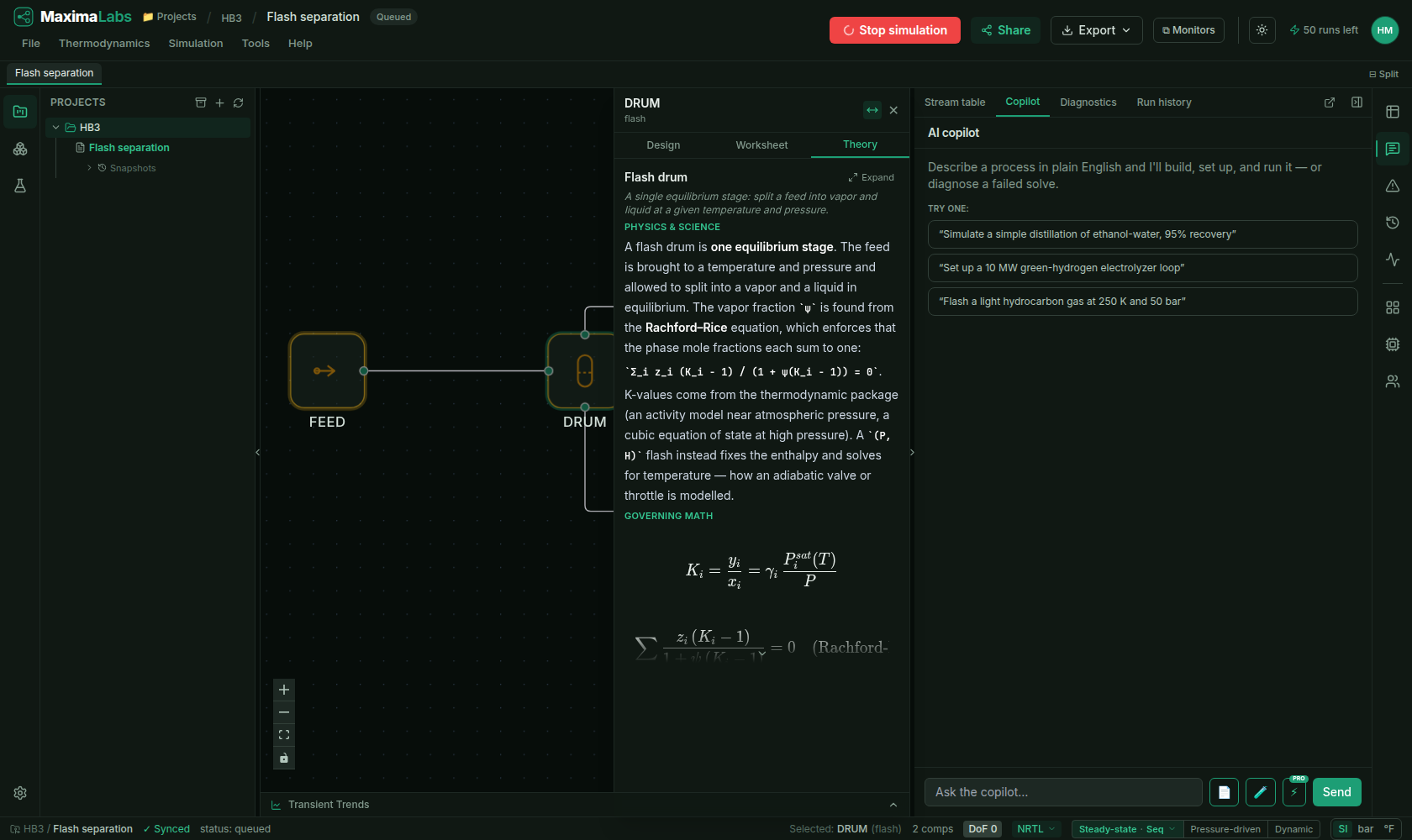
The flash drum's 'show the math' (ParamEditor ▸ Theory): the plain-English mechanism plus the KaTeX K-value and Rachford-Rice equations. The same panel notes that a (P,H) flash fixes enthalpy and solves for temperature — how a valve or throttle is modelled.
3.5 Bubble and dew points
Two limits of the flash are worth naming because whole design specs hang on them. The bubble point is where the first bubble of vapor forms —
and the dew point is where the first drop of liquid condenses —
These are what the phase diagram of Chapter 2 traces out: the bubble curve and the dew curve. Solving for the T that satisfies each (at fixed P) is a one-dimensional root-find on the same K-values.
Take
3.6 The adiabatic (P,H) flash
Not every flash fixes temperature. When a stream is throttled through a valve, or two streams mix adiabatically, what's conserved is enthalpy, not T. The (P,H) flash fixes pressure and total enthalpy and solves for temperature and the split together — an outer energy balance wrapped around the same Rachford-Rice inner loop:
- Total feed enthalpy — known and fixed (what's conserved across the valve/mixer).
- Vapor- and liquid-phase molar enthalpy at the (unknown) outlet temperature T, from the thermo package.
- The two unknowns solved simultaneously: vapor fraction and outlet temperature (T also sets every K_i inside the inner Rachford-Rice solve, which is why this wraps the isothermal flash rather than replacing it).
That temperature drop across a valve — Joule-Thomson cooling — falls straight out of this. In MaximaLabs a flash drum with a duty instead of a temperature spec (duty = 0 for adiabatic) runs exactly this calculation.
3.7 Try it
- 1Open the flash separation example and Run it.
- 2Read the Stream table: the vapor product is ethanol-enriched and the liquid water-enriched — one stage of separation, driven purely by the difference in volatility the K-values capture.
- 3Click the DRUM node and open the Theory tab to see the Rachford-Rice and K-value equations it just solved.
- 4Open the flash drum's params and change the temperature (try 350 K vs. 365 K) and re-run — watch the vapor fraction and the split move as you cross further into the two-phase region.
- 5For the adiabatic case, switch the drum's spec from temperature to duty = 0 and re-run — now it solves for the temperature that balances enthalpy.
With a reliable flash in hand, the next chapters just stack it up: a reactor flashes its outlet, and a distillation column is a whole column of these equilibrium stages wired together.
3.8 Exercises
Work each problem yourself first, then reveal the solution to check it. Where a problem says so, reproduce it live in MaximaLabs — the solver is the answer key.
- 1warm-upA binary feedis held at conditions where the K-values areand. Without solving Rachford-Rice, decide whether the feed is two-phase.
- 2coreA feedis exactly at its bubble point at some temperature where the light key has. What K-value must the heavy component have?
- 3challengeA warm liquid is throttled across a valve to a lower pressure and partially vaporizes. Using theflash, explain why its temperature falls, then reproduce the effect in the flash separation example.