Assay Characterization
TBP/ASTM D86/D1160 crude assay curves are cut into pseudocomponents via Riazi-Daubert (Tc/Pc/MW from NBP+SG), Edmister (acentric factor), Watson K, and a Kesler-Lee ideal-gas Cp(T) — the same pseudocomponent seam any EoS package flashes through.
thermodynamicspetroleumpseudocomponents
Concept
A crude/refinery feed isn't a list of named components — it's a TBP (True Boiling Point) distillation curve plus a specific-gravity profile. Assay characterization cuts that curve into equal-volume pseudocomponents, then regresses each cut's critical properties from just its normal boiling point and specific gravity.
The math
Show the governing equations
Kesler-Lee then supplies an ideal-gas Cp(T) for each cut so it flashes like any other pseudocomponent through the same EoS seam.
Execution
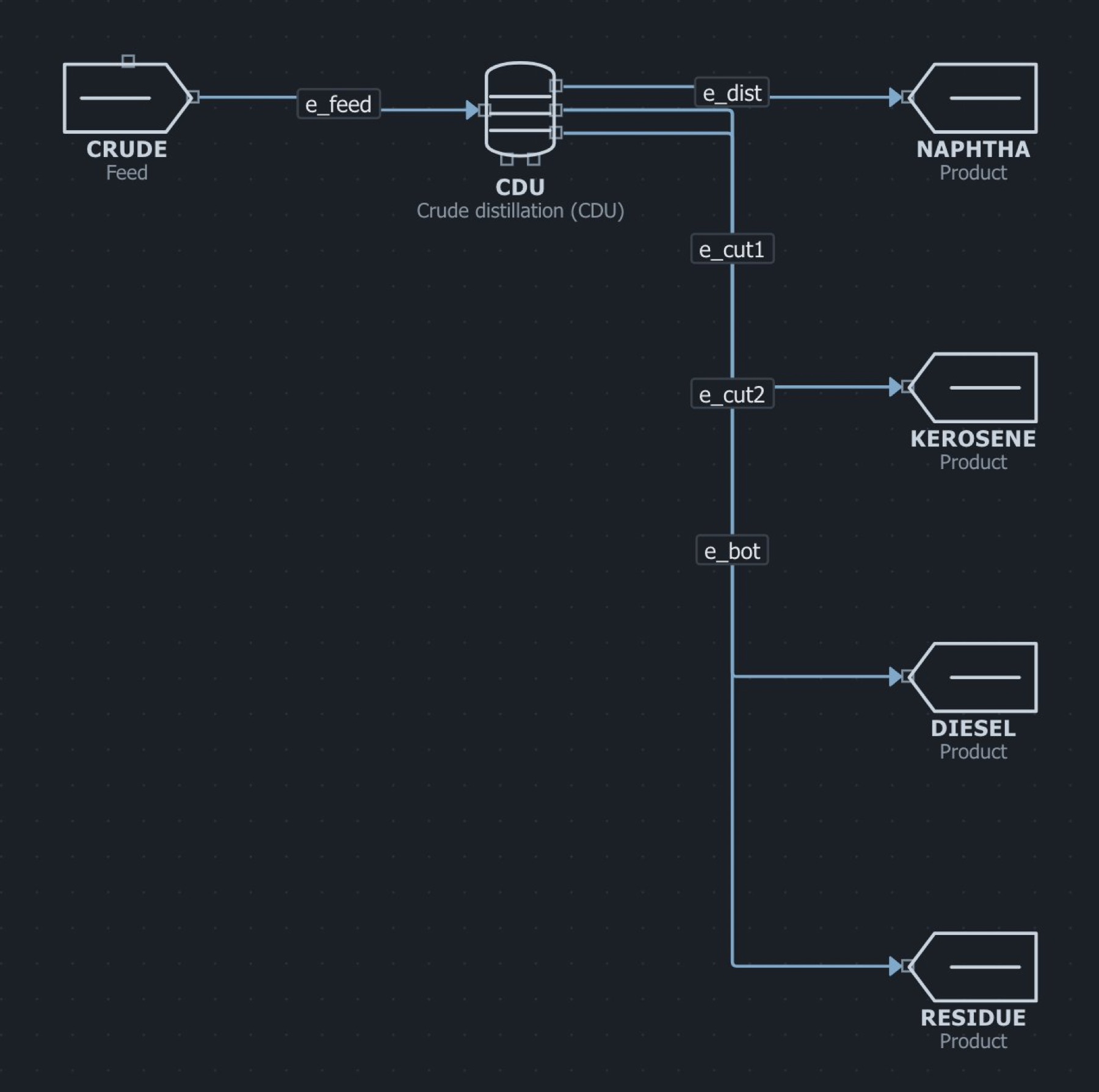
The example as it opens in the workbench. Click to enlarge.
ASSAY_INFEASIBLEA petroleum assay curve could not be characterized into pseudocomponents (e.g. a non-monotonic TBP curve).