Polymerization Reactors — CSTR Cascade vs. Tubular (PFR)
A free-radical CSTR or PFR reactor with method-of-moments Mn/Mw/PDI, plus cross-stage MWD blending so a CSTR cascade reports a true cumulative molecular-weight distribution instead of just its last stage's local production — the real answer to whether a tubular reactor gives a tighter MWD than a CSTR train (it doesn't, and here's why).
A free-radical polymerization reactor's job is to report not just how much monomer converted, but the molecular weight distribution (Mn, Mw, PDI) that determines the polymer's mechanical properties. Two reactor topologies are common in practice — a CSTR cascade (3-5 tanks in series) and a tubular (PFR) reactor — and it's a common assumption that the PFR's plug flow gives a "tighter" molecular weight distribution. That's true for the residence-time distribution (no long-tail under/over-reacted material, unlike a single CSTR), but it is not true for the instantaneous-chemistry MWD: a PFR's monomer concentration — and therefore its instantaneous chain length — drifts continuously from the inlet condition down to the outlet condition, while each CSTR stage makes its own chains under one fixed, local monomer concentration. Blending chains made at different instantaneous chain lengths always broadens dispersity above the local value.
Show the governing equations
A real, solved comparison
The same monomer feed, split 50/50 into two trains at equal total reactor volume (12.6 m³): a 3-stage CSTR cascade (each stage blending its own new polymer with the MWD already carried forward from the stage before it) versus a single PFR. Solving both trains gives:
| Train | Conversion | Mn | Mw | PDI |
|---|---|---|---|---|
| CSTR cascade (3 stages) | 81.3% | 9.7 | 23.2 | 2.39 |
| Tubular (PFR) | 89.4% | 10.7 | 29.7 | 2.78 |
Molar masses in kg/mol. The rate constants are published styrene/AIBN values at 350 K; the monomer is a stand-in carrying styrene's molar mass, so this is not a specific commercial styrene process — the comparison is what to trust, not the absolute magnitudes. Reproduce it yourself in the workspace below.
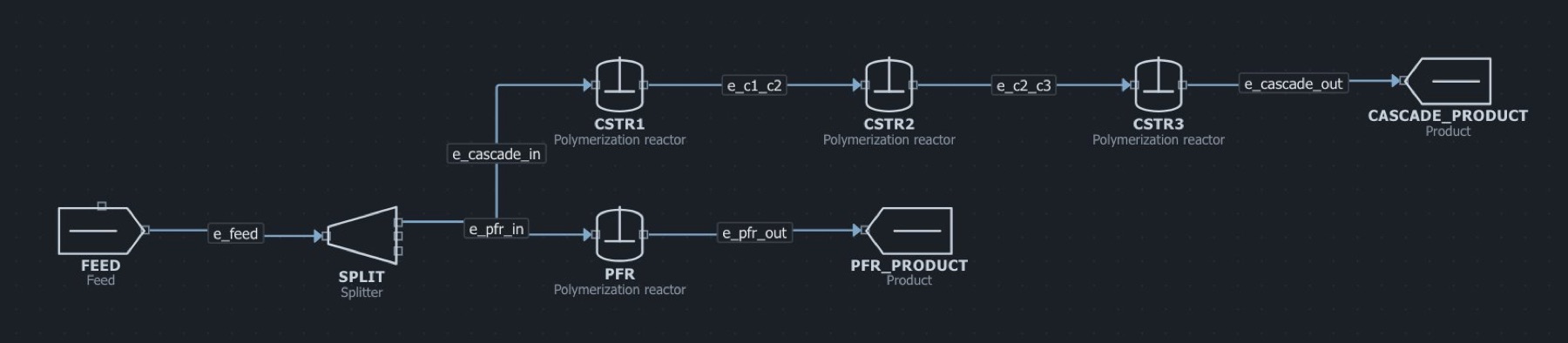
The example as it opens in the workbench. Click to enlarge.
What this does not model
- Single monomer only — no copolymer composition drift.
- Disproportionation-only termination (PDI baseline 2, not combination-termination's ~1.5).
- No initiator depletion along the PFR's length — the same constant-radical- concentration assumption the CSTR path makes, extended along the tube. This is exactly what makes the PFR case solvable in closed form; adding depletion would need a real ODE integration.
- Method-of-moments only — no full chain-length distribution (no Flory/Schulz-Zimm shape), and no true residence-time-distribution solver anywhere in the platform today.