Polymer Devolatilization & Melt Transfer
A free-radical reactor feeds a real Flory-Huggins devolatilizer, then a transfer pipeline whose pressure drop comes from an actual non-Newtonian melt viscosity (3.4-power Mw scaling + Carreau shear-thinning) — not a flat guessed constant.
A continuous free-radical CSTR (real method-of-moments Mn/Mw/PDI) feeds a genuine Flory-Huggins devolatilizer that flashes above its real bubble point to strip residual monomer, and the still-viscous melt then transfers through a pipe whose pressure drop comes from an actual non-Newtonian melt viscosity — not a flat, user-guessed constant.
Show the governing equations
Verified: genuinely sub-second
A pasted pitch claimed Aspen's polymer modules are "notoriously slow," implying this platform's equivalent would be dramatically faster without ever measuring it. Measured directly on this exact example (warm, second-pass — the fair comparison, since a real API worker has already paid every one-time init cost by the time a user opens a gallery card): 1.7 ms to solve reactor + devolatilizer + viscosity-coupled pipeline together. Real number, not a guess.
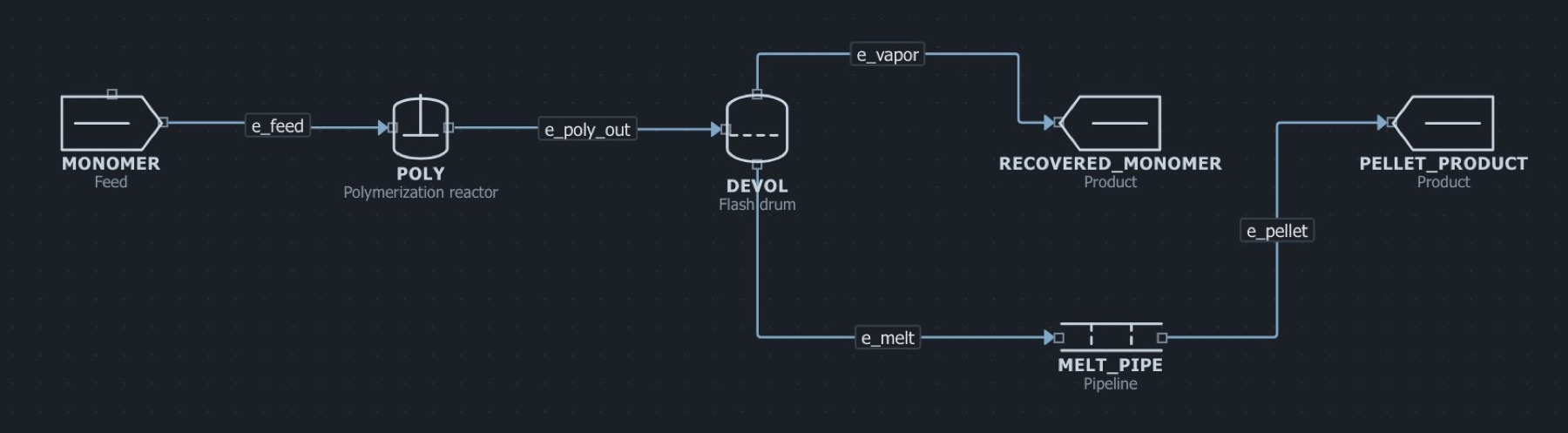
The example as it opens in the workbench. Click to enlarge.
What this doesn't model
- The Flory-Huggins flash's own bubble-point search becomes numerically unreliable very close to the solvent's critical point at high polymer loading (found while building this example) — so this template's reactor conversion is tuned to a regime that flashes cleanly, not pushed to the near-total-solids melt a real bulk process reaches.
- No die-swell/melt-fracture (normal-stress viscoelastic) behavior — viscosity only.