Direct Air Capture, Calcination & Liquefaction
Two DAC pathways — a liquid-KOH contactor + rotary-kiln calciner, and a lower-temperature solid-sorbent fluidized bed with real compression heat recovery — both into genuine CO2 liquefaction, plus this platform's built-in Scope 1/2/3 carbon-footprint and Capex reporting from one click.
A Carbon Engineering-style DAC train: a liquid-KOH contactor captures CO2 from ambient air, causticized and precipitated pellets calcine in a real indirectly-heated rotary kiln (Arrhenius decomposition kinetics, Sullivan-Maynard-Valentine residence time), and the released CO2 is compressed and chilled into genuine subcooled liquid CO2 — not just dense-phase pipeline gas.
Show the governing equations
Verified Scope 1/2/3 + Capex, genuinely one click
Open the Report view on this example: Economics/Capex and Carbon/Sustainability render side by side from the same solved flowsheet, and one "Print / Save as PDF" button produces both sections in a single document — a real claim, not marketing copy. Precisely stated: this is a real, correctly-computed analysis pass over the solved result (real emission factors, not fabricated numbers) — it is not literally a field carried on every Stream/node object the way flow or temperature are; don't oversell "native on every node" beyond what that means.
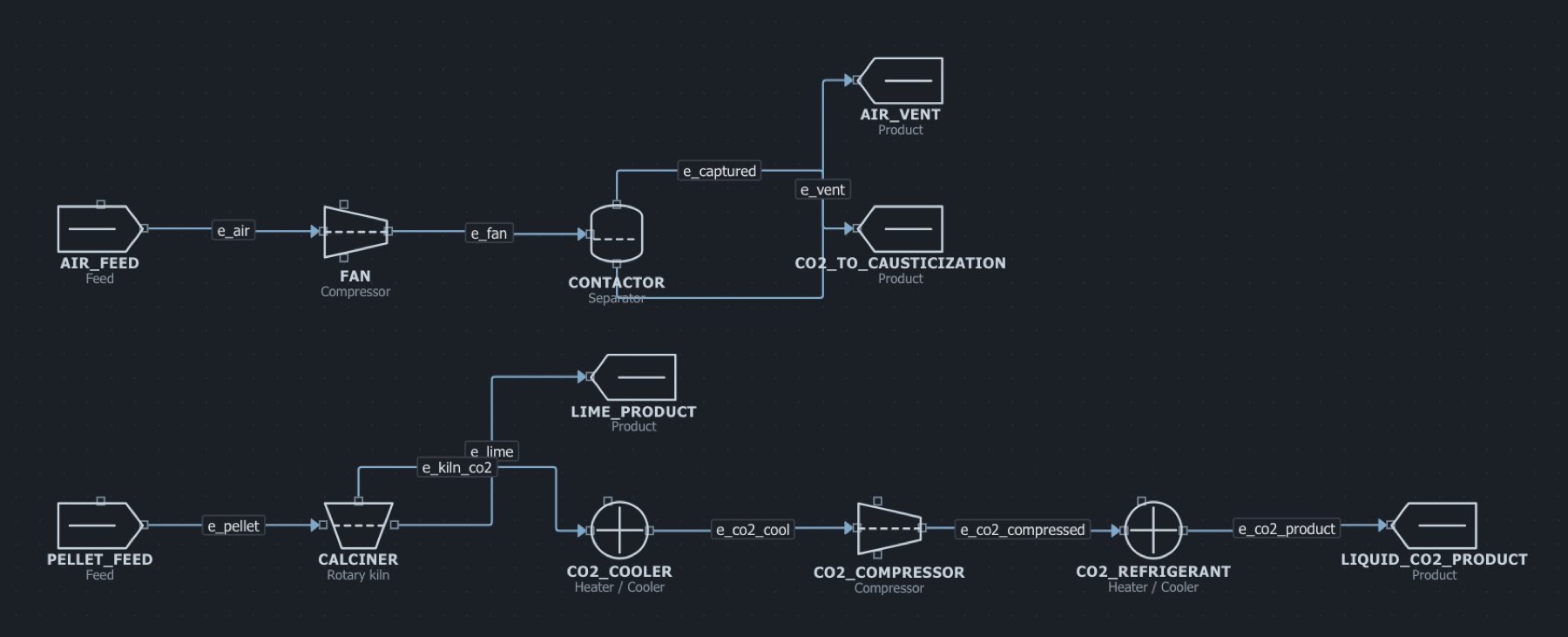
The example as it opens in the workbench. Click to enlarge.
Solid-sorbent DAC sorbents regenerate far below a KOH/CaCO3 loop's ~977°C calcination — this second example desorbs a loaded solid sorbent in a real fluidized bed (Wen-Yu minimum-fluidization sizing + Arrhenius desorption kinetics) at 120°C, self-swept by recycled product CO2. The desorbed gas is hot enough after compression (~780 K) that routing it through a heat exchanger against process water — instead of rejecting that heat to cooling water — genuinely converts subcooled liquid water into a boiling mixed-phase stream: real waste-heat recovery, the actual principle behind mechanical vapor recompression (MVR). Honesty note: this recovers real compression heat into a useful utility stream, but does not feed it back into the fluidized bed's own desorption duty (a fixed parameter on this unit op, not a second heating-utility stream) — a literal closed MVR loop onto the desorber itself isn't wireable with this unit op as built.
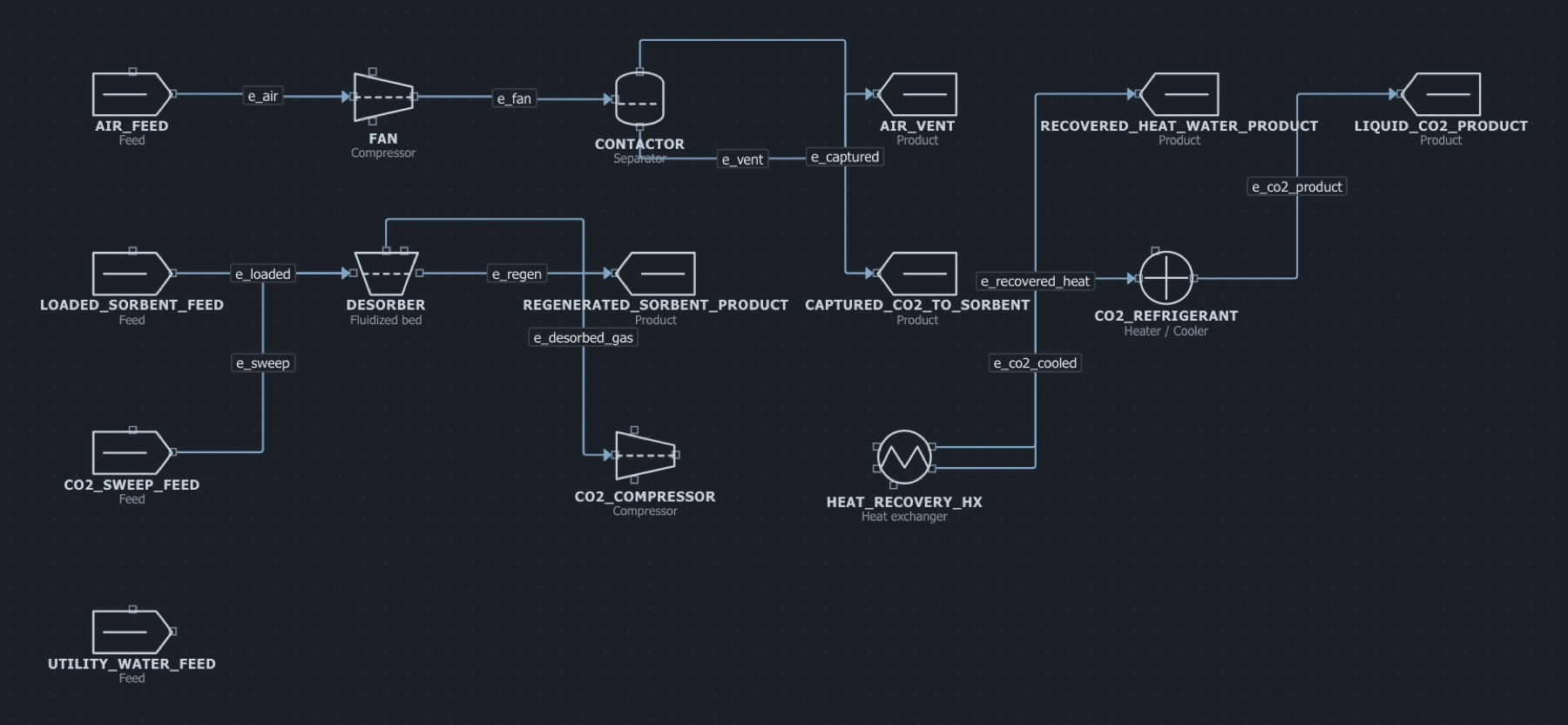
The example as it opens in the workbench. Click to enlarge.