Equation-oriented vs sequential-modular flowsheet convergence
Sequential-modular solves one unit at a time in topological order and tears recycles, accelerating them with Wegstein. Equation-oriented makes every stream in the plant an unknown and solves them simultaneously with a damped Newton on a sparse finite-difference Jacobian. The difference shows on tight recycles: measured on the same loop, 78 tear passes against 5 Newton iterations.
Sequential-modular solves the flowsheet the way you would by hand: sort the units topologically, solve each one from its inlets, move on. A recycle breaks that order, so the solver cuts the loop at a tear stream, guesses it, sweeps the loop, compares the guess with what came back, and repeats — accelerated with Wegstein.
Equation-oriented refuses the ordering. Every inter-unit stream becomes an unknown, every unit contributes residual equations, and one damped Newton solves the whole plant at once on a sparse finite-difference Jacobian. There is no tear stream because there is no sequence to break.
Show the governing equations
Measured on the same flowsheet
A tight ammonia synthesis loop — about 10% conversion per pass, a 5:1 recycle-to-fresh ratio, argon accumulating until a purge balances it — solved both ways:
| Sequential-modular | Equation-oriented | |
|---|---|---|
| Iterations | 78 tear passes | 5 Newton steps |
| Tear streams | 1 | none |
| Final residual | 9.0e-7 | 6.9e-12 |
| Wall clock | 2.2 s | 3.8 s |
The last row is the one usually left out. Equation-oriented took fifteen times fewer iterations and converged five orders of magnitude tighter, and was still slower on the clock, because each Newton step costs a finite-difference Jacobian over every stream in the plant while a tear pass is just one cheap sweep. EO wins where sequential-modular struggles or stalls — very tight recycles, many interacting loops, specs that must hold simultaneously — not automatically everywhere.
Which to reach for
- Once-through or loose recycle: sequential-modular. It is the default and it is cheaper.
- Recycle ratio above roughly 3:1, or a loop that will not settle: equation-oriented.
- Several design specs that must all hold at once: equation-oriented, since the specs become equations in the same system rather than nested outer loops.
- A flowsheet that fails to converge in one mode is worth trying in the other before touching the model — they fail on different things.
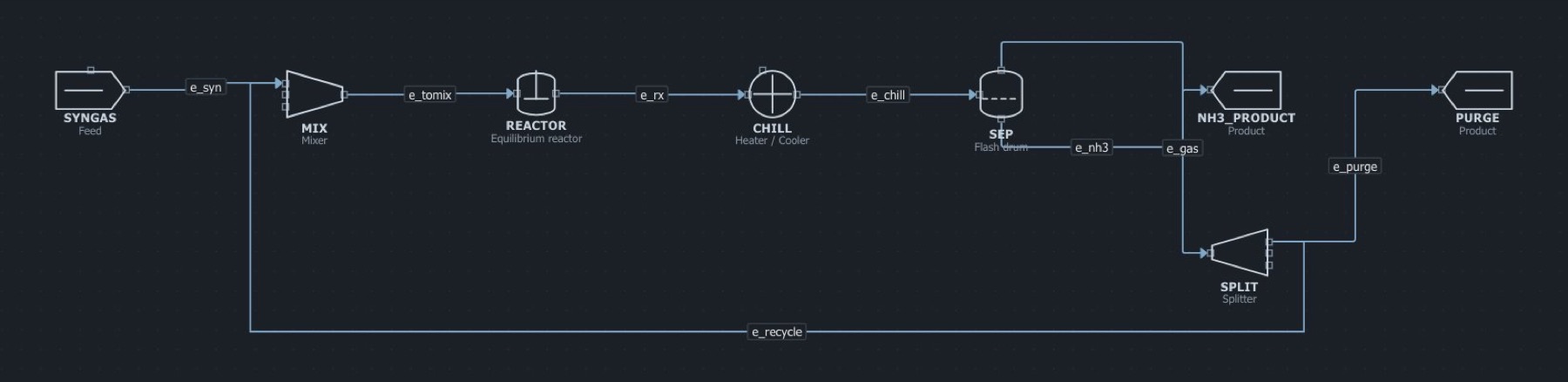
The example as it opens in the workbench. Click to enlarge.