Heterogeneous Azeotropic Distillation
A genuine vapor-liquid-LIQUID (VLLE) column: an entrainer carries water overhead as a ternary heteroazeotrope, decanted into organic/aqueous layers via UNIFAC LLE — the three-phase convergence legacy simulators are notoriously fragile at.
The classic failure mode legacy simulators struggle with: a column whose overhead condenses into two liquid phases (a genuine vapor-liquid-liquid equilibrium, VLLE), not one. An entrainer carries water overhead as a ternary heteroazeotrope; a real UNIFAC liquid-liquid flash decants it into organic and aqueous layers, and — in the heterogeneous-reflux mode — one of those layers becomes the column's actual internal reflux, closed by an outer fixed-point loop around the MESH solve itself. No manual Column → Decanter → recycle wiring needed on the canvas; the column does it internally.
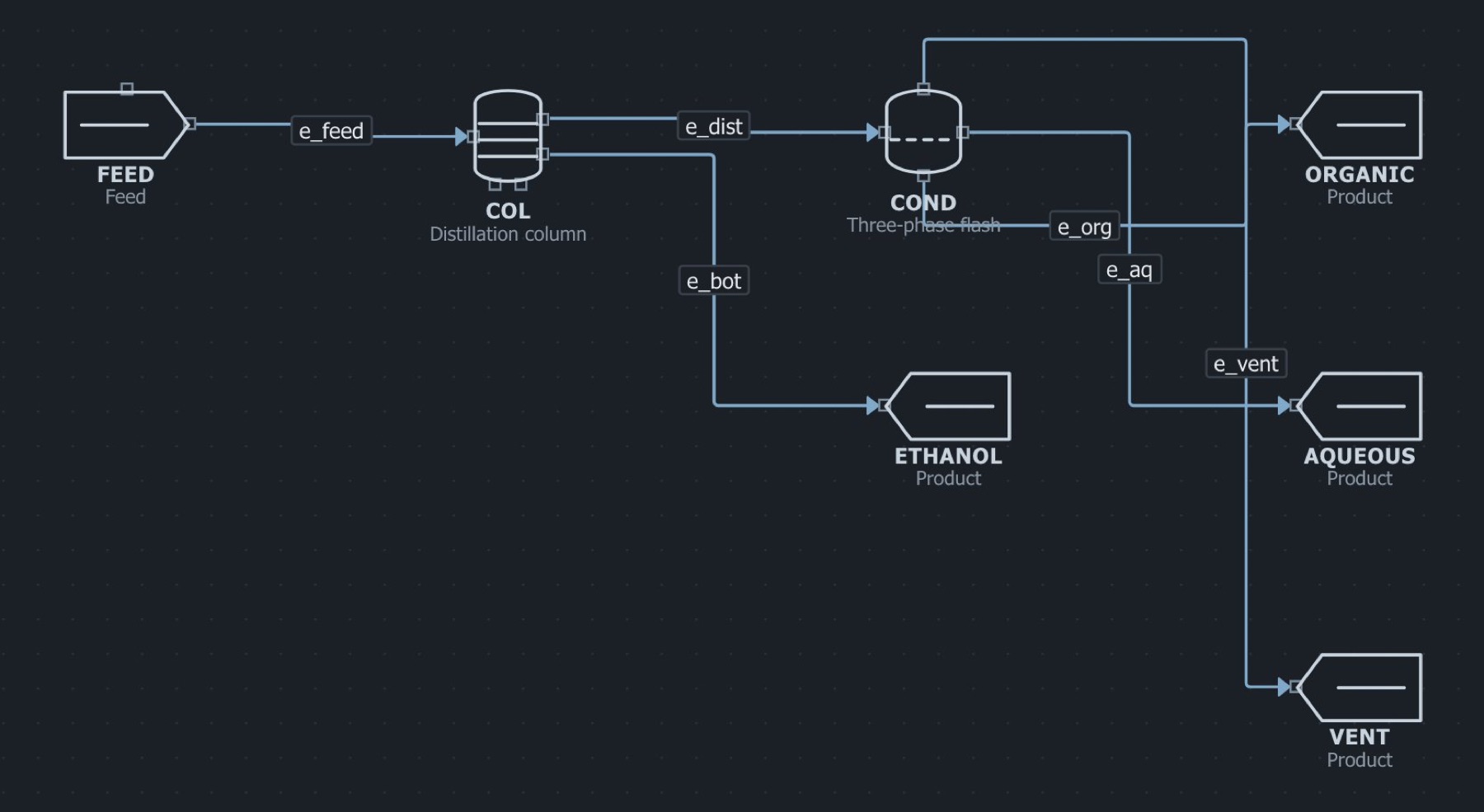
The example as it opens in the workbench. Click to enlarge.
Two claims from a pasted pitch that don't hold up
- "NRTL-HOC" (Hayden-O'Connell vapor-phase association) doesn't exist here. What's real is a van't Hoff dimerization model, but it's scoped to one hard-coded component (acetic acid), not a general Hayden-O'Connell correlation — don't cite "NRTL-HOC" as a package name this platform ships.
- Live drag-to-resolve phase envelopes don't exist for this column type. The canvas does have a real drag-to-scrub McCabe-Thiele preview — but that tab is McCabe-Thiele, a binary-column method, and is intentionally not offered for a VLLE column at all (McCabe-Thiele doesn't apply to a ternary two-liquid-phase system). Dragging a reflux ratio here still triggers a real, correct, but ordinary async re-solve — not an instant client-side envelope redraw.