Patent Benchmarks & Process Replications
Four real patent processes replicated as solved flowsheets — one matching the patent's own published numbers, one landing a quantified 1.8 points short of them for a structural reason the patent's own conversion figure implies, one demonstrating real new physics (gas-liquid mass transfer + chemolithoautotrophic kinetics) a prophetic patent describes but discloses no numbers for, and one validated against a fitted-conversion approximation — plus an honest account of a fifth patent this platform can't yet replicate without fabricating thermodynamic data.
A trust signal, not a competitive claim: replicating a real, published patent process as a solved flowsheet and checking the result against the patent's own disclosed numbers. None of these five patents were technically hard for a process simulator — Aspen and AVEVA could model most of them too. What they prove is that this platform's numbers are real, not that it's uniquely capable at any one of them. Every number below is from an actual solve, pinned by a regression test — not an invented "predicted vs. patent" table.
| Patent | Patent's claim | This platform's solved result |
|---|---|---|
| CN104628563A (methyl lactate) | 98.8% conversion, 99.6% purity | 98.8% conversion (set directly), 97.8 mol% purity — see below |
| US9359625B2 (cannabinoid synthase) | >20% conversion; ~10:1 THCA:CBCA at pH 5.0 | ~25.0% conversion; 10:1 ratio (fit point) |
| US6495732B1 (C3 hydrogenation) | "Essentially all" dienes/acetylenes removed, no propylene loss | >99.5% removed; propane mole fraction unchanged |
The methyl-lactate row used to read 98.75%, and that number was wrong. It was read off a column that never closed its component balance — 2.60 mol/s of methyl lactate leaving a column fed 1.98, i.e. 32% of the "product" was fabricated by a non-converged profile. The cause was the property method: Peng-Robinson mixes through van der Waals rules, which carry no hydrogen bonding, and every pair in a methanol / water / lactic-acid / methyl-lactate mixture is hydrogen-bonded. On PSRK (a cubic mixed through UNIFAC) the same column converges to a 2.7e-06 component-balance residual with every component leaving in exactly the amount the reactor made, and the honest bottoms purity is 97.8 mol%. The 1.8-point gap to the patent is arithmetic, not tuning: 1.19 points is unconverted lactic acid, which at the patent's own 98.8% conversion is unavoidable and boils above the ester (505 K vs 418 K), so no lights-removal column rejects it at any stage count; the other 0.99 points is the deliberate 0.798-vs-0.800 light-cut margin. Reaching 99.6% needs a second product column or an acid recycle, and this flowsheet has neither.
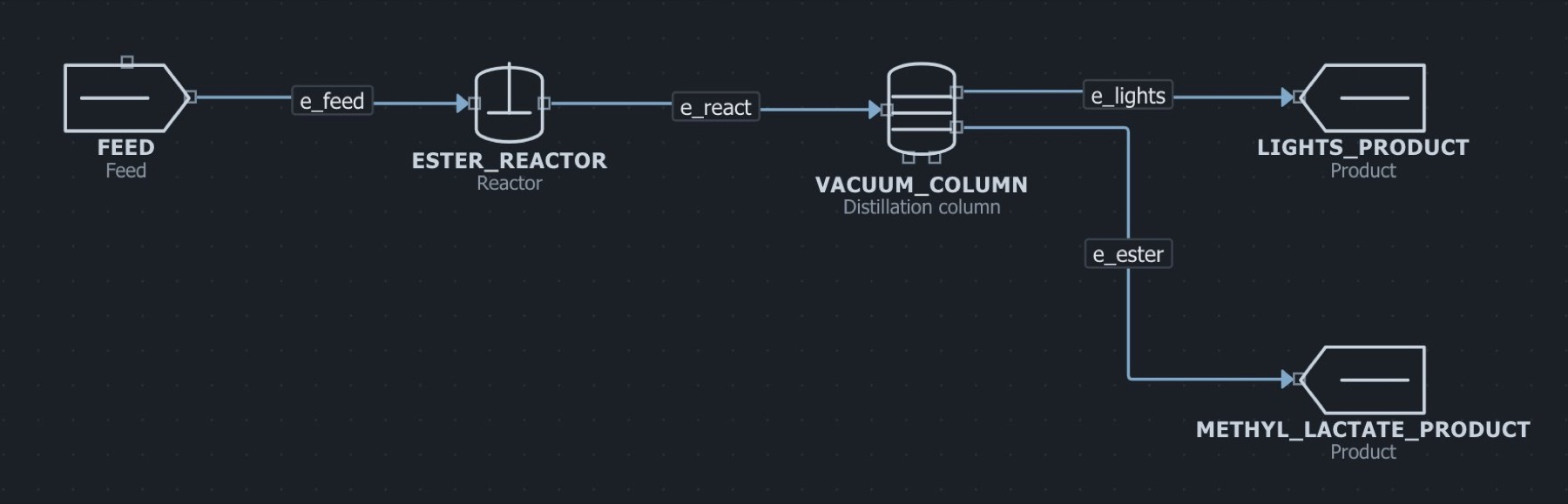
The example as it opens in the workbench. Click to enlarge.
JP2024028821A (Kiverdi-style gas fermentation to single-cell protein) is a prophetic patent — it discloses zero yields, rates, or operating conditions. There is nothing published to validate against. Built anyway, honestly framed as a capability demonstration, not a replication: real gas-liquid mass transfer (Henry's-law dissolution + a volumetric kLa) feeding a real chemolithoautotrophic growth model (McCarty's electron-balance method) — two genuine physics gaps this platform didn't have before this pass, not a Monod-on-dissolved-substrate shortcut relabeled.
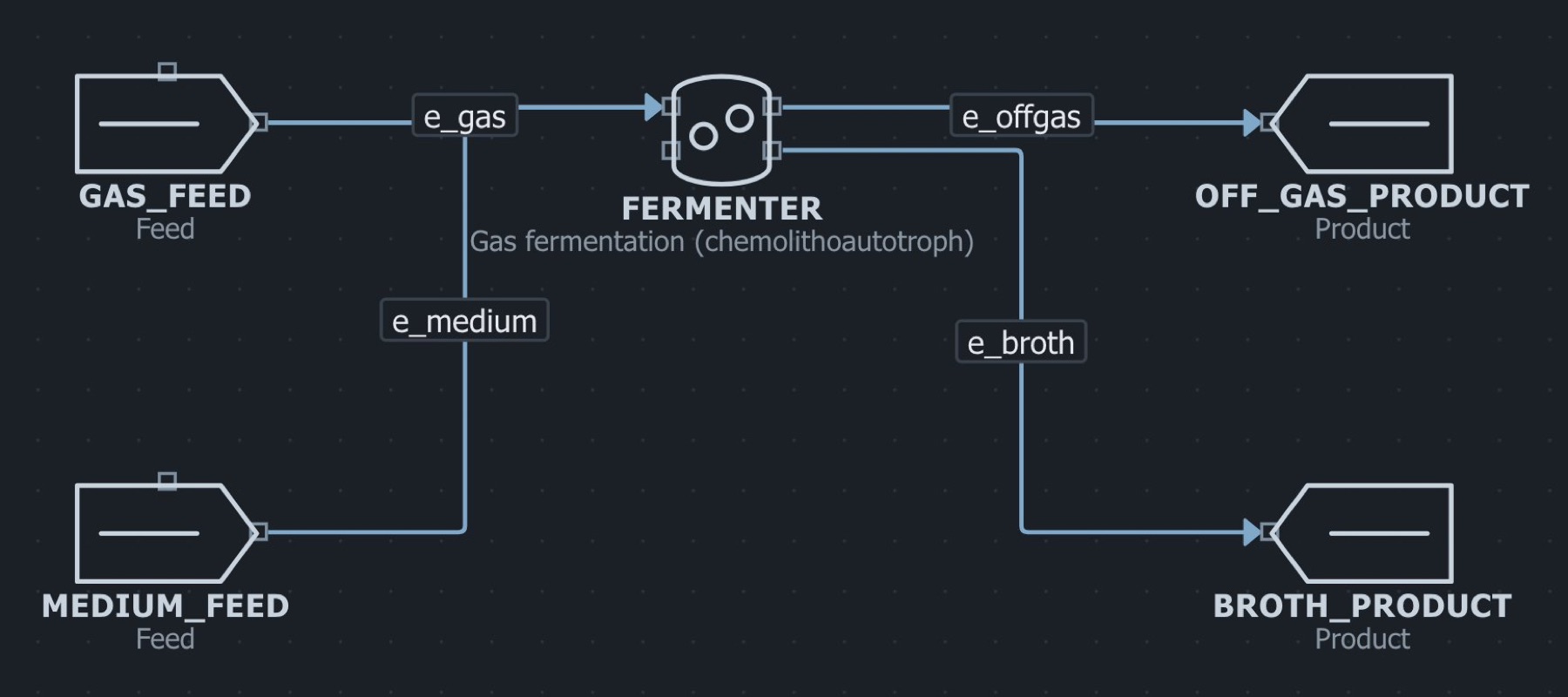
The example as it opens in the workbench. Click to enlarge.
US5399244A — genuinely blocked
US5399244A (DMSO-extractive benzene distillation) has real, rich published data — a worked feed composition, column configuration, and a specific raffinate purity result. It is not built. DMSO's sulfoxide functional group isn't covered by this platform's UNIFAC group table, and no NRTL binary interaction parameters for DMSO/hydrocarbon pairs are pinned anywhere in this codebase. Reproducing the patent's specific number would require either fabricating binary interaction parameters or recalling them from memory with no way to verify them — exactly the fabrication risk this whole exercise exists to avoid. An honest gap beats a plausible-looking wrong number.